

Get to Know the OEL | Dr. Andy Hogue
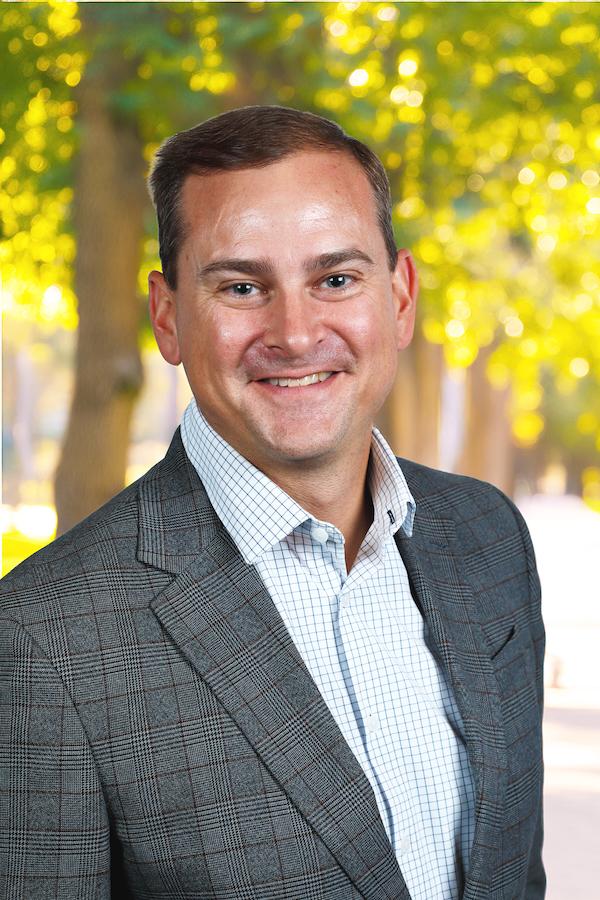
Dr. Andy Hogue serves as Associate Dean for Engaged Learning and directs the OEL. Usually in our "Get to Know the OEL" series, he asks the questions. In our latest installment, we flip the camera and ask him!
Q. Who is Andy Hogue? Where did you come from? What is your background? And how did you make your way here?
I grew up in Columbia, South Carolina and studied communication and economics as an undergraduate at Clemson University. I’ve often told students that I knew I had professors, and I knew the university paid them a salary, but it somehow didn’t occur to me that that was a real job—like, a thing you could do with your life, a thing I could do with my life. I was a mediocre student, though, until something clicked in the back half of my undergraduate years, and I realized I was curious about a lot of things in the world, and I liked thinking about important issues. One of my buddies then told me, in a kind of good-spirited ribbing—it was not a compliment—that I was destined to grow up and become a college professor who wore sport coats with elbow patches and sneakers. I’d never even considered the professor thing, but I liked the idea. Alas, here we are. I own some elbow patches and wear sneakers almost every day. But because I’d been a mediocre student, I like to say that I snuck into graduate school through the back door. It was hard, but I found my footing. And while I was certainly interested in the content I studied—you have to be—I always knew I was most interested in considering that content alongside undergraduate students of my own. I wanted to teach! And as I dipped my toe in those waters, something in me felt like it was coming alive. When I finished my PhD here at Baylor in political science, I landed a dream job as assistant professor of American politics at Whitworth University in Spokane, WA. We picked up and moved, and it was terrific. My wife, Tiffany, continued to work at Baylor, though, doing this novel thing (in those days) we called “remote work.” So, when the Baylor power brokers realized they couldn’t work without her (she’s brilliant), they started to pull her back this direction. A pathway opened for me, and the rest is history. It can be a real challenge for many families if both spouses are in higher ed, so we feel deeply fortunate and grateful that Baylor has given both of us the chance to flourish.
Q. What is your work in the OEL? What do you enjoy about it, and what is its impact on students?
I serve as our associate dean, which means I direct the office and get to have a small hand in all the things we do. When I assumed this role seven years ago, my job was to create the OEL, so it’s felt, for all that time, like a startup. I tend to thrive amid variety, and I enjoy the work of strategy, innovation, and generating ideas. To borrow a line from my friend Doug Henry, dean of our Honors College, I’m probably in the best job I’ll ever have. The best part of it, of course, is that all of it is directed toward helping students “blow the top off” their Baylor education, to use a phrase coined by my mentor Betsy Vardaman—to help them, that is, discover the good they want to do in the world as leaders, scholars, and citizens, and show them how to get there. What could be more rewarding?
Q: Describe for us, in layperson’s terms, your research.
If I’m doing my research well, it should be understandable to a layperson. I’m interested in how we work toward the common good. The further you go in your education, the more the system, perhaps rightly, compels you to narrow your focus. I often say that I narrowed my interests accordingly until the day I earned that last diploma, and then I set out on a journey to spend the rest of my life broadening them. I’m not a very good political scientist. That’s because I’ve found a lot of fertile work to be done in the adjacent spaces of philanthropy and social innovation, where everyday folks are positioned for a kind of citizenship that can make the world better. My research tries to articulate why and how. And to do that well, I like to engage diverse fields, like poetry, psychology, philosophy, theology, entrepreneurship, and history.
Q. If we do this Q&A again in a year, what will we be celebrating?
Good grief, I hope the publication of at least one of the two book projects I can’t seem to finish.
Q. Who are some of your heroes, and how do they show up in your life?
My grandfather was an ordinary man who lived a remarkable life. He was the youngest of 13 kids, orphaned when he was a toddler, raised by brothers and sisters, then forged his age to enlist in the army. Uncle Sam sent him straight to the European theater, where horrors awaited: the brutal march across the continent, the Battle of the Bulge, and eventually the discovery and liberation of Nazi concentration camps across Bavaria. Can you imagine—19 years old, a boy really, discovering humanity at its rock-bottom worst? He returned home at the end of the war and had to finish high school! The GI Bill then sent him to get a teaching degree, and his first teaching job turned into a principal job, which turned into a series of jobs as a school superintendent across South Carolina. If you know anything about public education in South Carolina in the 1950s-1970s, you know that many small towns resisted Court-mandated integration. My grandfather was masterful at helping communities arrive on the right side of history, which is why he kept moving; more communities wanted his leadership. He died suddenly when I was 14, but over and above all the good things he did in the world, he believed in me with every ounce of his being, and he always made me feel like a million bucks. I won’t do all the remarkable things he did, but he shows up in my life in real ways every day, inspiring me to be a better educator, to commit to the long, steady work of making the world better, and to inspire and assist people in their efforts to do good in the world.
Q. What do you hope our students will take from their Baylor education, and what do you see as your role in that?
I’m quite fond of a fancy word for a simple concept: meliorism. It means simply that the world can be made better by human effort rightly directed. Each of us is a font of possibility, a wealth of resources—our intellect, our energy, and our influence, our imagination, our knowledge, our networks and relationships, our money, our talent, our time. Rightly directing these things can make the world better. And it’s our job, our purpose, I think our calling to dispatch those resources so our neighbors, communities, and indeed the whole cosmos might flourish.
Q: Tell us about the Andy Hogue outside Baylor, and take that any direction.
My family first: my amazing wife, Tiffany, is also a Baylor professor who serves these days as chief of staff to President Livingstone. We love working 100 yards from each other, and it’s not uncommon to find us taking a short walk around campus together to catch some fresh air. We have two wonderful daughters. Anna is a junior at Clemson studying nutrition. Caroline is a junior in high school, and we enjoy cheering her on in theatre and sports. Golf is my favorite hobby. I was a competitive junior player, and I mostly set it aside for 30 years (school took over, then my kids weren’t interested, so I waited until they grew up). I’m trying my best to reach scratch (a zero handicap), and I got SO close this summer, reaching a 0.1 before reality set back in. I also love international travel (our family has led several Baylor study abroad programs), reading widely (mostly literary fiction, poetry, and essays), playing outdoors (especially hiking and skiing), and watching sports (love my Clemson Tigers, Baylor, too, plus the PGA Tour, Arsenal, and the Atlanta Braves).