

Fulbright Dispatch From Germany
Olivia Gorrell (B.M. '22, piano and German major) shares her experience on a Fulbright English Teaching Assistant award to Germany from 2022-2023.
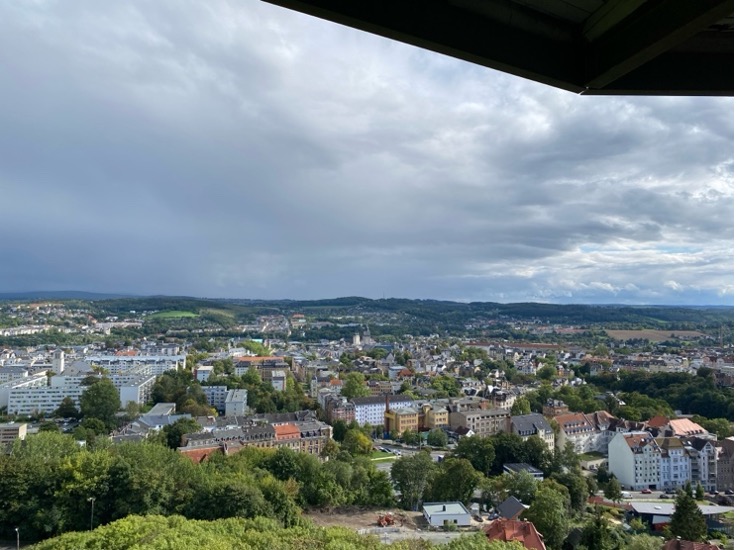
I am now three years out from my experience as a Fulbright English Teaching Assistant (ETA) in Germany, and every day I am reminded of the amazing experiences I had and wonderful people I met during my year abroad. In April of 2022, I received an email from the Fulbright Commission with the exciting news that I would be placed in two schools in Auerbach, Saxony, a small village about forty-five minutes from the Czech border. My assignment was to serve as a teaching assistant in two Oberschulen, the equivalent to American middle schools. Working with students ages ten to sixteen, I spent each school day attending English classes with the students and teaching lessons about American culture, history, sports, and food. My students were especially excited to learn that I was from Texas—they asked many questions about cowboys, rodeos, and country music, and they even asked if we had kangaroos! Getting to share aspects of my country with these curious students brightened my day and gave me a greater appreciation for cross-cultural exchange.
When I wasn’t working in the schools, I was traveling to see the beautiful countryside and historic places surrounding Saxony. I was based in the Vogtland, a stunning region of rolling grassy hills and dense pine forests straight out of a fairytale by the Brothers Grimm. In addition to its natural wonders, Saxony contains many beautiful castles that were only a short train-ride away from my apartment. One of my favorite memories of my time in Germany was at the Burg Mylau, a medieval stronghold built during the twelfth century. One of the teachers at my school invited me to join him for a classical organ concert in the beautifully decorated chapel, which featured a vaulted ceiling and intricately carved depictions of angels and saints. Sitting on the wooden pews with a handful of others, inhaling the scent of incense, and listening to stunning organ music in such a historic place was truly a once-in-a-lifetime experience.
While my time as an ETA was filled with travels both within and without Germany (including Prague, Czech Republic; Salzburg, Austria; and Strasbourg, France), the truly remarkable experience of living and working in a country not my own was found in my day-to-day life. From renting an apartment and navigating a rental lease completely in German, to shopping in the local grocery store and discovering foods I’ve never tried, each day held new, unexpected experiences. As one of the only Americans in my city, I made an effort to make connections with my community very early on in my stay by attending a local church. There was a thriving young adult ministry into which I was immediately welcomed, and the kindness shown to me by the families in the church was something I will never take for granted. Moving abroad to a country with a different culture and language is not an easy transition, but because of the generosity of the people I met, I soon felt a part of the community and learned to adapt to a new way of life.
As part of this newfound community, I got the opportunity to participate in a monthly event called Café International, which was open to foreigners in the city to meet native German speakers and have coffee and pastries. Each time I went to this event, I met different people from around the world, including men, women, and children from countries like the Netherlands, Greece, Ukraine, and Syria. Sitting at the table surrounded by so many different languages was simultaneously disorienting and awe-inducing—despite our differences (and often the strong language-barrier), we managed to share our stories and cultural heritages over strong German coffee and delicious pieces of Apfelkuchen. Those meetings became the highlight of each month as I looked forward to seeing my friends from all over the world.
It’s experiences like these that truly made my time as a Fulbright Scholar remarkable, and I would encourage anyone who has a love for cross-cultural exchange and new experiences to apply. Yes, the process is long—it was over a year from the time I started my application to when I heard about my selection as an ETA—but the process is worth it. Even if you are a year or two out from when you are eligible to apply, it’s never too early to start preparing. Look through the whole host of countries with Fulbright awards available, and research the different kinds of awards. Choose a country and start investigating its history and culture. If possible, take language classes to improve your communication skills. The more you have a personal connection to a country and a deep understanding of its people, the more you can share that connection in your essays and interview. Most importantly, however, if you are selected, go into the experience knowing that, for all the opportunities that you may get to share your own culture, the real Fulbright experience is learning from the people around you and allowing them to help you grow.