

Dispatch from a Baylor Summer Fellow | Abby Winkelman
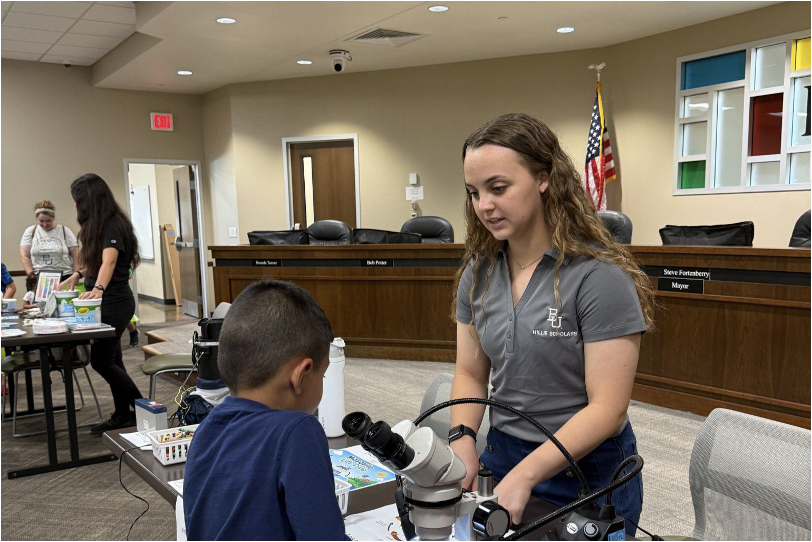
As I raise my final colony of mosquitoes for my summer research project with Dr. Jason Pitts, I have a lot of time to reflect on my experience. I’ve found that research means more than the data generated and hours spent dissecting and staining mosquito antennae and spermathecae. By dedicating an entire summer to research, I’ve gained valuable skills that will serve the community I am so passionate about.
At the beginning of the summer, I stood as a bright-eyed undergraduate, excited about the experiments I would run and the implications they could have for the world. However, as all researchers have experienced at some point, of course, I received results that didn’t meet my initial expectations. Through trial and error of experiments and hypotheses, I’ve learned to accept findings as pure data rather than a total failure or complete success. The value of research is to learn from everything, even if the result doesn’t initially lead to developing a hypothesis, and the important part is to keep exploring rather than give up. It is so easy to be discouraged by a single result, but there is always something new to learn, which can lead to even greater discoveries that could have huge implications for society.
This summer, I’ve also developed some incredible insights into new hypotheses that need further testing and discovery. The reworking of ideas, diving deeper into literature, and designing experiments have allowed me to develop grit that I can carry on to other projects and life goals. Additionally, this summer has taught me how to share my research and present complicated biological systems in a way that is understandable to a general audience. Discovery doesn’t mean anything unless it can be made digestible for the general public. Scientific communication is an extremely important skill to develop, especially in mosquito research, as it can affect change in the global health landscape.
Presenting to my class of B-TRUE Summer Fellows about my laboratory’s research was extremely challenging and rewarding, but I most enjoyed teaching young kids about mosquitoes at a community outreach program. This experience reminded me that starting with the basics of mosquitoes and their life cycle is important for the community to know, as it will lead to important information about disease control in the future, laying the
groundwork for global health implications.
In summary, I am extremely grateful to have spent my summer in research. Trying to find time during the semester, between classes, to run into the lab takes away part of the experience that full-time research provides. I’ve struggled, I’ve succeeded, and I’m leaving my summer fellow position with a greater understanding of the persistence and kind of person it takes to make a difference in the world of research.
I’m excited to continue contributing to the field of vector sensory biology and to use the skills I’ve built to serve the greater good of society.