

Get to Know the OEL | Dustin Benac
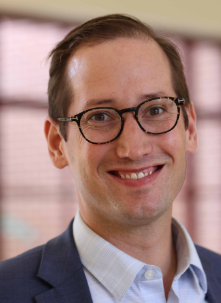
Dr. Dustin Benac serves as the Senior Director for the Future Communities Lab in the Office of Engaged Learning and is a Clinical Assistant Professor in the College of Arts & Sciences. This Q&A is the eighth installment in our "Get to Know the OEL" series.
Q. Who is Dustin Benac? Where did you come from? What is your background? And how did you make your way here?
I grew up in small town Texas in a family where questions were encouraged and faith was fostered. My dad was an engineer who had a seminary degree, and my mom was a physical therapist who later started a faith-based mentoring non-profit. From my earliest years, writing was part of the way I made sense of the world the work—including a collection of childhood poems that I thought would be my first book—and I grew up learning to hike, fish, and take risks through some extended periods of time with family and friends in southwestern Colorado.
Looking back, I think it was a combination of these people and experiences that set a trajectory for the work I continue to do today. I can remember a conversation when I was eighteen where I shared how I’d one day like to be a professor, but I had real living framework about what that would involve or the pathway to take. I studied theology, leadership studies, and philosophy at Whitworth University in Spokane, Washington, drawn equally by a love of the Rocky Mountains and a chance to explore questions about faith, leadership, and institutions on the other side of Christendom.
I had incredible mentors in college and graduate school who invited me to consider a pathway I could not have imagined for myself, but I also experience crisis and loss when a college friend died tragically in a car accident. In these and other forms of crisis, I realized the structure of community has to be able to carry the full breadth of human experience. I did my graduate studies at Duke University, where I continued to chase questions about faith, formation, imagination, and institutional leadership. I ended by doing an interdisciplinary doctoral program that included sustained training in the classical theological disciplines alongside research in philanthropy and organizational theory. My primary field is Practical Theology, which provides a way to do community-centered, translational research for the common good.
Along the way, I cut my teeth professionally and academically is a grant writer and grant manager, and I’ve now spent twenty years in the grant space. I came to Baylor in 2020 as a Visiting Assistant Professor and Louisville Institute Postdoctoral Fellow. Shortly after I arrived, I was fortunate to be invited to co-found a new initiative at Baylor that is now the Future Communities Lab and apply for serve as a Co-PI on a large grant. After spending years studying the conditions that allow individuals and communities to adapt to shifting organizational environments, it was a dream to be invited to build a resource, relationship, and research hub that could foster a hopeful imagination for the future of church, community, and civic life.
Q. What is your work in the OEL? What do you enjoy about it, and what is its impact on students?
I serve as the Senior Director for the Future Communities Lab and teach in the Philanthropy and Public Service Program. The mission of the Future Communities Lab is to support the thriving of congregations and community leaders by piloting solutions to the complex challenges communities face. This collaborative work is carried by a fantastic team, and we have the joy and privilege to work with incredible students, congregations, and community leaders. I work together has four pillar: convening, curriculum, contextual research, and collaboration. I am amazed and encourage every week by the outstanding people and stories that we encounter—these students and communities provide so many reasons to be hopeful about our shared future!
I also absolutely love being in an interdisciplinary space that promotes institutional innovation. We see students as our conversation partners and colleagues in the research, writing, and learning we are doing together. In doing so, I hope students receive the training and support they need to be change makers in their local communities and develop an expanded imagination for what is possible through collaboration, philanthropy, and community-centered practice.
Q: Describe for us, in layperson’s terms, your research.
My research and writing explores the conditions and practices that allow individuals and communities to adapt to shifting organizational environments. We will all navigate transition and uncertainty in our lives and communities in various ways: change is unavoidable. My research shows how rootedness within a faith community and tradition of practice provides the resources that are needed to navigate change and innovation with creativity, faithfulness, and imagination. While I primarily work within Christian congregations and communities and reflect on the Christian tradition, I am also curious about how certain forms of shared human experience can create opportunities for meaningful connection and community across various forms of distinctives and particularity. The potential for connection in this way is part of what has drawn me to study and write about crisis, belong, loneliness in leadership, and mental health challenges.
I am also working to establish a new interdisciplinary field at the intersection of Practical Theology, Philanthropy, and Organizational Studies that supports the future for communal life. The identification of this as a new field simply attempts to name the type of work individuals and communities are doing already at these intersections, while also creating the institutional containers that are needed to nourish the future of the common good.
Q. If we do this Q&A again in a year, what will we be celebrating?
Wow, I have three books that I hope I will have handed off to a publisher before the year is up! More importantly, we’re building some exciting pathways for expanded community partnership and engagement with students through the Future Communities Lab, and I hope that we’ll be celebrating more people are gathering around this collaborative work.
Q. Who are some of your heroes, and how do they show up in your life?
My mentor and doctoral advisor, Craig Dykstra, had a profound impact on the shape of my life and current work. Craig served as the Vice President for Religion at the Lilly Endowment, Inc. for twenty-three years, and he shaped the field of Practical Theology and American religious life through his writings, philanthropic leadership, and vision for education and institutions. My earliest experiences in undergraduate research were actually supported by a Lilly grant to Whitworth University that was made during Craig’s tenure, so our early conversations simply emerged out of an expression of gratitude.
Craig modeled a hopeful vision for the future of a common life that was always animated by the reality and possibilities of God. Without dodging the complexities of contemporary challenges, he seemed to hold out hope that life truly was better when it was learned in the company of others and lived for the sake of others. He modeled a spirit of generous convening in his scholarship and leadership, inviting me and others to a shared table where friendships could form. There was a breadth to Craig’s curiosity and conversation partners that reflected a dynamic imagination and an abiding commitment to friendship.
If you had the privilege to work with or learn from Craig before his passing in 2025, you would know that he carried a relentless commitment to the common good and a hopeful vision for the future of our churches, communities, and civic life. Craig was first and foremost a Christian educator, and much of my work and writing is simply continuing to work out the questions Craig fostered in me, which I now can see was part of his brilliance as an educator and master teacher.
Q. What do you hope our students will take from their Baylor education, and what do you see as your role in that?
I hope our students will gather three things from their Baylor education: 1) a hopeful vision for the future of their life and the communities they serve; 2) connections and meaningful friendships—with students, faculty, and staff—that they can carry with them beyond their time at Baylor; and 3) a sense that there is meaningful change that they want to be a part of in the world.
I regularly say that our students at Baylor provide innumerable reasons to be hopeful about the future of communities, and I think part of my role is helping them see the hope that I and others already see in them. Along the way, I want to nourish a community-rooted imagination about what is possible together, such that they can continue to navigate the changes that will come with clarity, connection, and a sense of meaning and purpose.
Q: Tell us about the Dustin Benac outside Baylor, and take that any direction.
You can’t really get to know me without getting to know the people that matter most to me. That would include my wife and life-long creative partner, Casey, who is a Licensed Professional Counselor that has served in her private practice for more than ten years. We have been married for fifteen years and have known each other for almost three-quarters of our lives, so we quite literally have had the gift of growing up together. Being parents to our children is one of our greatest joys: Cade (10), Ellie (8) and Ames (4) are brilliant, active, and humorous, each in their own way!
Reading, writing, and running are markers of health in my life, and I’m always eager to have conversations about any of these topics—or looks for ways they can overlap in meaningful ways. When I’m not on the soccer fields coaching or cheering on my kids, you may be able to find me on a river somewhere chasing fish with a flyrod in hand. I occasionally joke that being a fly-fishing guide was the other meaningful vocational pathway for me if had not gone to college, but I am holding out the possibility that there’s still time for that vocational expression!