

Get to Know the OEL | Mark Richards
This interview has clearly not been edited for brevity.
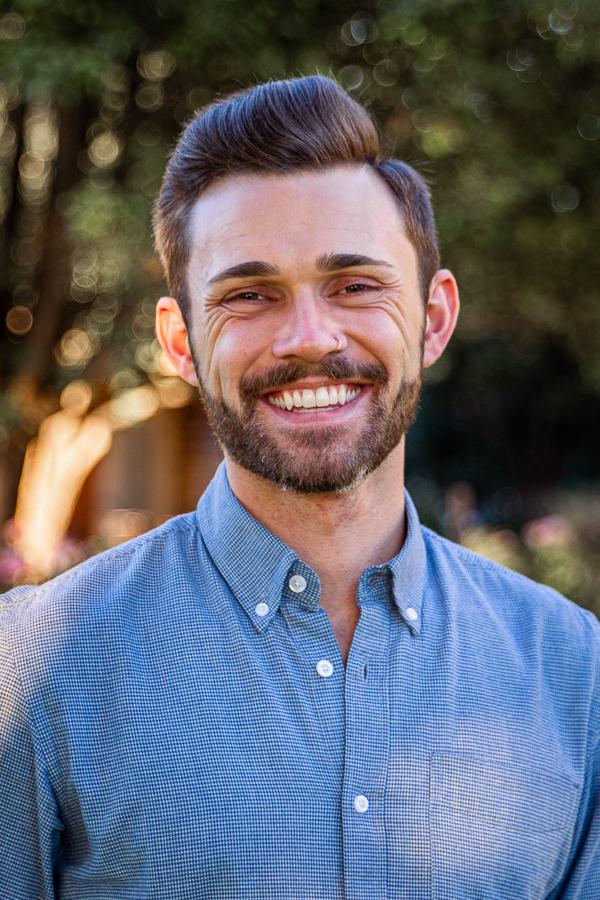
Mark Richards serves as Associate Director for Operations, Innovation, and Programs in the Office of Engaged Learning. This Q&A with Andy Hogue is the fourth installment in our "Get to Know the OEL" series.
Q. Who is Mark Richards? Where did you come from? What is your background? And how did you make your way here?
A. “Who is Mark Richards?” A light question to start! Well, I like long walks on the beach—oh wait, wrong Q&A. I originally hail from Southern California (so I actually do love long walks on the beach) and made my way to Baylor for undergrad, where I was a Business Fellow and Finance major and had a number of wide-ranging experiences across the university, including taking your Philanthropy and the Public Good course and studying abroad in Maastricht under you and your wife Tiffany’s instruction. After graduating (in 2019, for anyone counting) and taking an epic summer road trip, I moved to Chicago to work in management consulting for Accenture for a couple years, where I learned a lot and gained some great experience—and also ultimately realized I wanted to derive more meaning and purpose from my daily work than I felt I was able to there. While working at Accenture, I also volunteered regularly with an organization called Praxis in New York City that runs accelerator programs for Christian business and nonprofit founders. My role there was strictly operational—helping run several of their many events—and I found that I really loved being in an execution-oriented operations role. Combining these two insights, and particularly on account of wanting to find more meaning in my work, I actually quit my job at Accenture in 2021 without having another one lined up yet. I wouldn’t necessarily recommend this to everyone (I had some savings to fall back on, which factored heavily into my decision), but I felt like I became philosophically burnt out on the work I was doing, and I thought devoting some extra time to discerning what might be next would be helpful. And it was! As I applied to new roles, I realized that just doing operations would feel like receiving marching orders that I may or may not agree with, and I also have this part of me that is deeply strategic and thoughtful about the big picture and how things ought to run—what those marching orders ought to be, in other words. So I shifted to looking for roles that might satisfy both parts of me, and I found one at a very small, 6-person retirement planning firm as their operations specialist, though I functioned as more of a director of operations. That role was fantastic for me and allowed me to do a wide range of both operations strategy and execution work—mapping and redesigning key processes, researching and implementing new systems, and much, much more—and it also gave me room to grow in both of these competencies. After two years in that role, I made my way back to Baylor in fall 2024 after you came calling, Andy—or texting, as it were—about a possible opening on the OEL team that I was well-suited for. You were looking for this exact kind of blend of a strategic thinker and an operator to help the OEL execute on its wide range of work, and I jumped at the opportunity.
Q. What is your work in the OEL? What do you enjoy about it, and what is its impact on students?
A. My title is a bit of a mouthful—Associate Director for Operations, Innovation, and Programs—but the gist of my role is this: alongside our Associate Dean, you, I help our team execute the broad range of work we do (operations), I think strategically about the whole scope of our work and how we might improve and enhance it (innovation), and I also help direct and administrate our leadership programs (programs). Practically, this looks like a lot of things, as you might imagine based on that description—helping design the structure and programming for our leadership programs (Summer Fellows, Engage Fellows, Provost’s Scholars), then executing it during the year; designing and enhancing systems and processes that help our team work more efficiently (think spreadsheets, databases, automation, etc.); dreaming up, designing, and constructing resources for our students; helping administrate our PPS courses; co-leading the rollout of ForagerOne; helping run all our OEL events; improving our website presence and storytelling; and much, much more.
I love that the work I do every day is so wide-ranging and multi-faceted, and I absolutely love the OEL team I have the privilege of working alongside—they are a fabulous bunch of really lovely, thoughtful, hardworking, student-centered people, and it is genuinely a dream of a team to be a part of. And the impact of my work on students feels quite amazing and wide-ranging itself, because I get to impact students both directly and indirectly—directly through the ways that I help shape some of the OEL's student-facing work, like our leadership programs, and in my direct conversations with students, and indirectly through the ways I help our team members leading other initiatives do that work even better. It’s hard to describe in brief all that the OEL does, because it’s so much—URSA grants, PPS courses, Engaged Learning courses, major fellowships and awards, leadership programs, funded summer internships—and all of it is aimed at helping students see themselves as part of a larger whole and commit themselves to the flourishing of all people. That’s pretty inspiring work to get to do every day!
Q. If we do this Q&A again in a year, what will we be celebrating?
A. I hope we’ll be celebrating a huge uptick in the number of students taking Philanthropy and Public Service (PPS) courses next spring and fall (there are so many amazing courses on offer!), broad adoption of ForagerOne across campus, and some exciting work afoot with a new class of Provost’s Scholars. Also, as a peak behind the curtain, I hope we’ll be celebrating the soft-launch of a revamped tool for our students to design their “engaged” Baylor experience, some new and deepened partnerships across campus (with, e.g., the Sustainability Office and Intercultural Engagement), and maybe the inaugural OEL Homecoming Reception??
Q. Who are some of your heroes, and how do they show up in your life?
A. Oh, man. My mom, who is perhaps the archetype for me of a strong woman who did not let others define for her what she was capable of doing or being, and yet who is also full of deep love and the kind of tenderness that only comes through enduring hardship. She is literally and figuratively imprinted forever on and in my being. Dr. Martin Luther King, Jr. (who I took a PPS course on as an undergrad!), from whom I first learned that we as humans are “caught in an inescapable network of mutuality, tied in a single garment of destiny,” and whose lead I follow, in the greater path of the Lord Jesus (another hero), in believing that love is both “the greatest force in the universe” and “ultimately the only answer to humankind’s problems.” And Henri Nouwen, the celibate Catholic priest, writer, and wounded healer and lover of many, who has taught me that each of us is unshakably and immeasurably loved by God, and who has been a spiritual father to me in many respects. Those are three that immediately come to mind, but there are certainly many others!
Q. One of the things I appreciate about you, Mark, is that you are able to do strategy work and systems work while also being highly personable and people-focused. How do you think that came about?
A. In short, I have no idea. But I love people and interacting with people, and I also love systems and frameworks and neatly organized things like spreadsheets. I see strategy and systems as things designed and built by and for people, generally speaking, and it might be my design thinking background that tells me that at the core of anything designed for people, there are in fact people—“end users”—of that thing, and it’s best to keep a short distance between the design of a thing and the people “using” it. And furthermore, as much as I love a good spreadsheet or a tidy framework, interacting with people constantly reminds me that even our best ideas, theories, frameworks, and categories often break down or need reworking at a certain point because people are wildly unique and unpredictable. (I think of the difference between economics and behavioral economics; the former studies humans as decidedly rational beings—essentially automatons—while the latter studies humans as we all know them to actually be, namely influenced by all kinds of random, personal, often unpredictable things.) So for me, I think my loves of and experiences with people and designing strategies and systems based on true and coherent understandings and frameworks about those people have combined together in an interesting way. But I fear this answer became too heady, so see my first sentence!
Q. What do you hope our students will take from their Baylor education, and what do you see as your role in that?
A. I hope during the course of their time here our students are able to learn about themselves and who they have been created to be, and that they are able to begin to see themselves as part of a larger whole and orient their lives toward the common good (as we like to say in our office) in recognition of how much there is in this world to build, create, improve, reform, redeem, repair, renew, and reimagine for the sake of everyone’s flourishing. I hope they can begin to see their place(s) in that work, or if not yet, that they can have the tools and frameworks for discerning their place(s) in that work as their life’s journey continues. And I hope that our students will pursue the common good out of a recognition that each of us is called to this kind of work in our lives, at least because it is the right or just or virtuous thing to do, and, for our Christian students, because it is the kind of work God expects all of us who follow him to be engaged in, whether we might call it building God’s kingdom, bringing heaven to Earth, bringing about the reign of God, or pursuing God’s shalom. My hope is that in their Baylor education and in their lives beyond, our students would, in the words of the late Congressman John Lewis, “pray and move [their] feet.” And I see all of my role, in and well beyond the responsibilities noted above, as contributing to this kind of a Baylor experience for our students.