

Shepherd, Beno, DeLozier, and Zárate Honored with 2024-25 OEL Awards
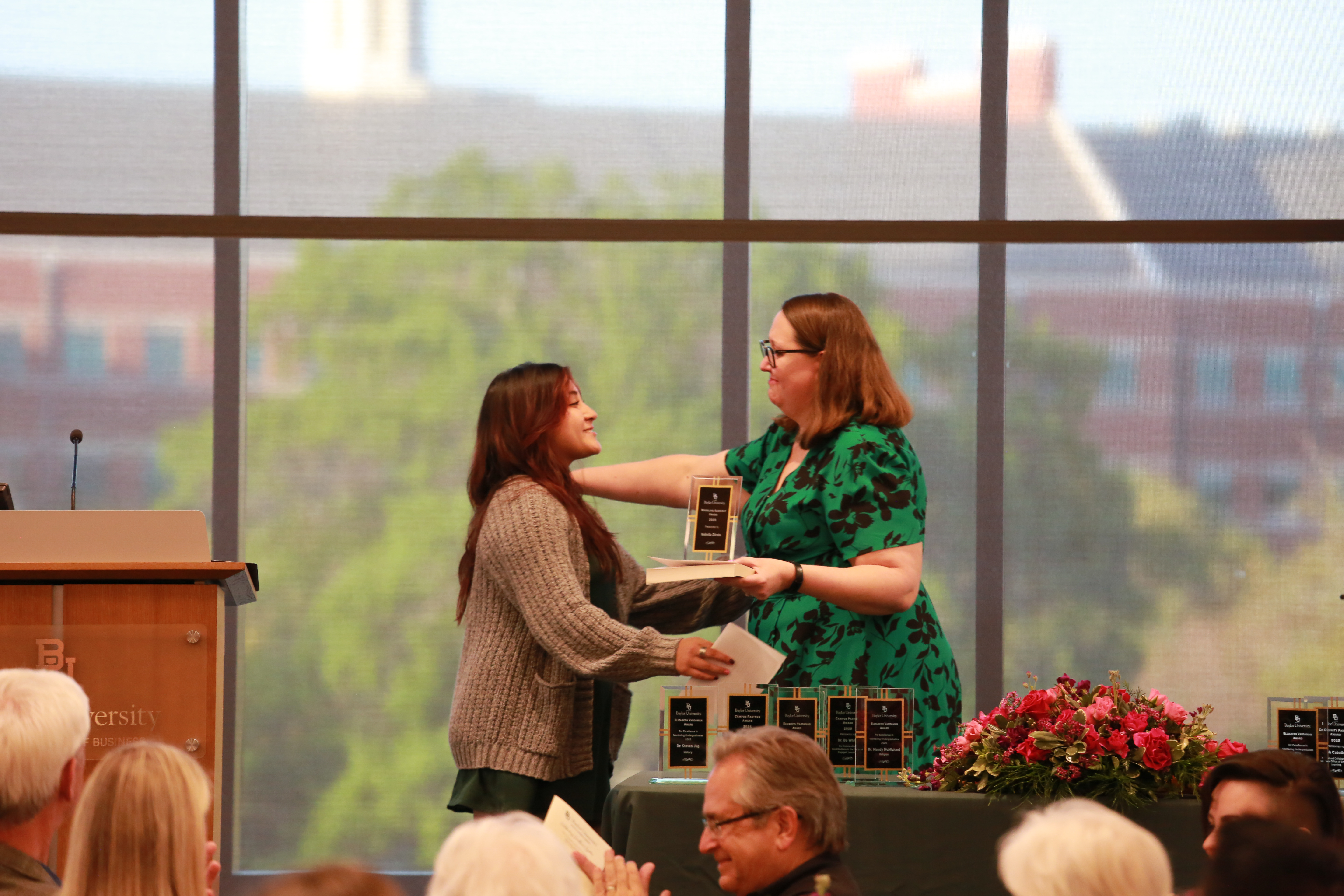
Waco, TX – April 2025 – The Office of Engaged Learning (OEL) celebrated the achievements of four outstanding students at its annual banquet, held April 9. The event highlighted the students' exceptional contributions in leadership, scholarship, citizenship, and ambassadorship, reflecting the core pillars of the OEL's mission.
Myles Horton Award for Leadership
The Myles Horton Award for Leadership was presented to Karly Shepherd, a senior University Scholars major with concentrations in Political Science, English, and Philosophy. Karly has demonstrated a profound commitment to facilitating civil discourse and interfaith relationships on campus. She holds leadership roles in Baylor’s Public Deliberation Initiative, Better Together, the Good Neighbear Podcast, and the Bridgebuilding Fellows. Additionally, she is a certified InterFaith Leader, an ESL tutor, and a coordinator for Baylor’s Intercultural Engagement programs.
Beyond the campus, Karly has interned with the Foundation for Individual Rights and Expression, worked on Penguin Random House’s Banned Books Initiative, and co-hosted the award-winning podcast UnTextbooked. Her dedication to social change through relationship-building and direct action embodies the legacy of Myles Horton, the "Father of the Civil Rights Movement."
Robin Wall Kimmerer Award for Scholarship
Sarah Beno, a senior Biology major with a minor in Chemistry from Albuquerque, NM, received the Robin Wall Kimmerer Award for Scholarship. Sarah is a Provost's Scholar and a passionate researcher, currently working on her Undergraduate Honors thesis on organ tissue proteomics in Dr. Solouki’s chemistry lab. She has been recognized with the prestigious Barry Goldwater Scholarship for excellence in undergraduate STEM research.
Sarah is also a Biology Student Ambassador and actively participates in Baylor's recruitment events. After graduation, she plans to pursue a PhD in Biochemistry and/or Molecular Biology, aiming to become a research director for industry labs.
Fannie Lou Hamer Award for Citizenship
John Austin DeLozier was honored with the Fannie Lou Hamer Award for Citizenship. A Provost’s Scholar, John Austin has made significant contributions through his work as an investigative legal intern, ESL conversation partner, and TA for the Learning for the World course. He has also worked on refugee matters in Greece, organized the Dead Poets Society, and served as editor of the undergraduate research journal The Pulse.
John Austin’s dedication to promoting the common good and uplifting others is evident in his diverse roles, including his internship at the Center for Christianity and Public Life in Washington DC. His commitment to citizenship is deeply interconnected with his leadership and scholarship.
Madeleine Albright Award for Ambassadorship
The inaugural Madeleine Albright Award for Ambassadorship was presented to Isabella Zarate, a dual major in International Studies and Environmental Studies. Isabella, an Honors student and member of the Baylor Interdisciplinary Core (BIC), was recently awarded the Charles B. Rangel Graduate Fellowship by the US State Department. This prestigious fellowship supports individuals pursuing careers in the Foreign Service.
Isabella has also been a finalist for the Truman Scholarship and is currently a finalist for a Fulbright Scholarship. Her future plans include graduate studies focusing on resource insecurity, climate resilience, and education access. Isabella’s leadership in Baylor’s Model United Nations Team and her academic achievements make her a deserving recipient of this award.
About the award namesakes
Myles Horton is often referred to as the “Father of the Civil Rights Movement.” He founded the Highlander School in 1932, the first and only integrated school in the south during the Jim Crow era. He believed that if marginalized people of all backgrounds could learn from one another in beloved community through civil discourse, they could affect powerful change. Horton and his school mentored major civil rights leaders like MLK Jr, Rosa Parks, and John Lewis, assuring them they weren’t alone in their fight.
Dr. Robin Wall Kimmerer is a mother, scientist, celebrated professor, and enrolled member of the Citizen Potawatomi Nation. Kimmerer is a SUNY Distinguished Teaching Professor of Environmental Biology at the State University of New York College of Environmental Science and Forestry, where she also directs the Center for Native Peoples and the Environment. Her writing is celebrated for its poetic and insightful approach, making complex ecological concepts accessible and deeply meaningful. As a writer and a scientist, Kimmerer's interests in restoration include not only restoration of ecological communities, but restoration of our relationships to land.
Fannie Lou Hamer was an icon of the Civil Rights Movement who, on account of her determined and tireless spirit in the face of lifelong adversity and injustices, became one of the most inspirational voting rights advocates and citizens in American history. She was born in 1917 in central Mississippi, and at just seven years old began working as a sharecropper on a plantation, picking cotton with her family. As a young girl, she excelled in school before withdrawing to help support her aging parents, but she continued to grow in her reading and interpretation. On top of being significantly affected by her contraction of polio, she was also subjected to much injustice throughout her life, including a forced sterilization procedure in 1961. In 1962, during a visit to the Mississippi Delta by civil rights workers from the Southern Christian Leadership Conference (SCLC) and Student Nonviolent Coordinating Committee (SNCC), Hamer heard for the first time about civil rights from James Bevel, and “her imagination was charged by new moral and spiritual energies.” She would spend the remainder of her life working to secure those rights for herself and for other Black residents of Mississippi. It was a brutal fight, and it times it cost her nearly everything, but it was one she waged with courage, commitment, and a distinctly Christian commitment.
Madeleine Albright was the first woman to be appointed U.S. Secretary of State, and she served in the position from 1997 until 2001. Prior to that Albright served as US Ambassador to the United Nations from 1993 to 1996. Albright was an immigrant from the former Czechoslovakia whose family fled to England to escape the Nazis and after returning to Prague after World War II, became refugees for a second time, immigrating to the United States after the communist coup when Albright was just seven years old. Albright was also a scholar, earning a Ph.D. in Public Law and Government from Columbia University. Before being appointed to her Ambassadorship, Albright was Research Professor of International Affairs at Georgetown University’s School of Foreign Service and Director of its Women in Foreign Service Program.
Contact Information: Office of Engaged Learning (EngagedLearning@baylor.edu)