

From Kant to Compost: Taking Ethical Theory Into the Field
Contemporary Ethical Theory took a unique approach this fall, partnering with a local nonprofit to bring ethical theory to life.
It was early August as I sat at the bar of my favorite local coffee shop, tinkering with a syllabus for the fall (alongside other Baylor faculty typing away at keyboards with the same frenzied pre-semester energy). I was slated to teach a course I have taught for years on a topic I also happily research: contemporary ethical theory. Typically, the students work through several of field shaping-monographs, punctuated by little excurses into applied ethical issues like animal rights, climate change, global poverty and food insecurity. But that August day I felt more unsettled than usual about this structure.
My mind wandered to memories of the previous year, when I was on leave and volunteering at a regenerative agricultural farm while finishing my book on human goodness. The book aims to bring out the continuity between the good for humans and for nonhuman organisms; and perhaps nothing was so orientating to that work as the time spent outdoors with gourds and goats (and a new tiny human who was strapped in for the ride). So, sitting at that coffee shop and struggling over the syllabus I stopped to consider: if being in this environment so significantly influenced my thinking about ethical theory, after working in and teaching it for over a decade, maybe undergraduate students would also find insight and inspiration if I took our learning outside the classroom and into the field.
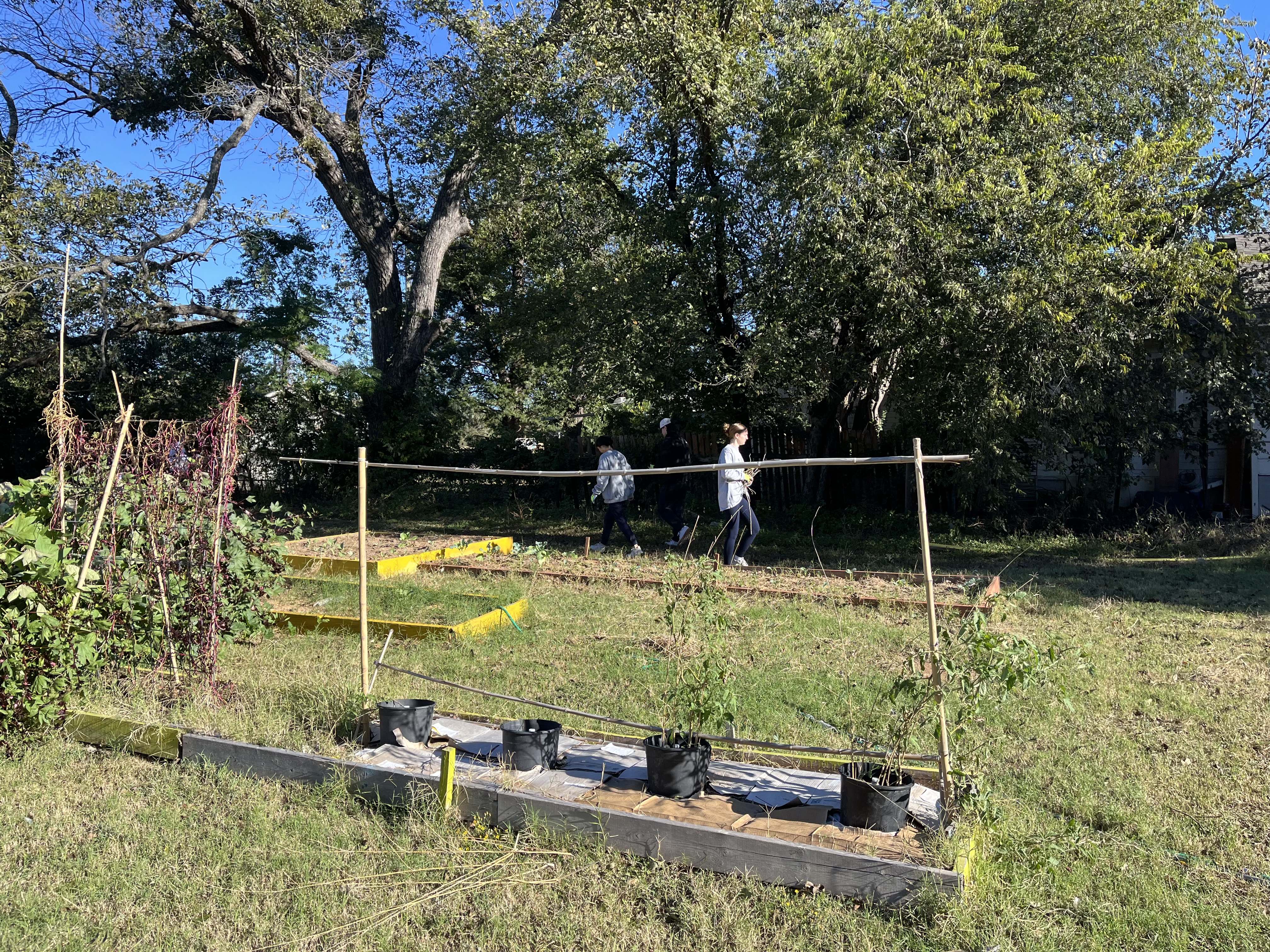
I picked up the phone and asked colleagues at OEL if they would be able to help me quickly pivot to make the class a more grounded learning experience for the students. They connected me to the head of Global Revive, an organization that has created and sustained community gardens in a food insecure area of Waco. And in two weeks, the class was up and running and building raised beds off of Elm Street. We were reading texts on the abstract ethical theories of Immanuel Kant on Tuesdays and mulching beds amidst monarchs on Thursdays while talking about whether nonhuman animals have intrinsic value, and what it means for our ethical treatment of them if they don’t.
The students quickly went all in. Some showed up early and stayed late on days we worked in the gardens or walked acres of rewilded prairie cared for by our community partners. They grasped difficult distinctions and arguments from the texts that students in past years had struggled with right up to the end of the semester. And they worked with our partner, Kay Bell of Global Revive, to imagine, plan, and secure a grant to host an Earth Day Symposium at Baylor—“to make Earth Day as big as Christmas” as Ms. Bell put it.
When the semester came to a close I asked them how they were able to do so well with the hard philosophical material, even when having less time in the classroom doing close readings and were occupied simultaneously by the work on the Earth Day project and volunteering in the gardens. There was broad agreement that two things were happening. First, once they started seeding plants, learning about the food it would grow into, being outside with animals they could no longer not care about the central questions of ethical theories (namely, what kinds of beings matter and what kind of treatment do those beings deserve). Second, they had one sustained and shared case study against which to test their ideas and intuitions about claims in ethical theories all semester. So instead of jumping around from one anecdotal example to another, with little overlap in experience, as a class we held a months-long conversation about, for instance, how to understand the value of biodiversity and whether the species or individual members of a species bear value, and what that means to proper treatment of those organisms.
Our class formed the sort of intellectual community I am always hoping for but cannot manufacture. I watched them, on our last day, playfully running up and down a mound of mulch the moved into garden beds while debating interpretations of Aquinas and Hegel on being. This is what I wanted to become a philosophy teacher for, and I am so grateful to be at a university with initiatives like engaged learning curriculum, where I can learn from my peers about how to be more creative in my classes and also connect with the community beyond the university in care of our common home.