

Get to Know the OEL | Dr. Rebecca Flavin
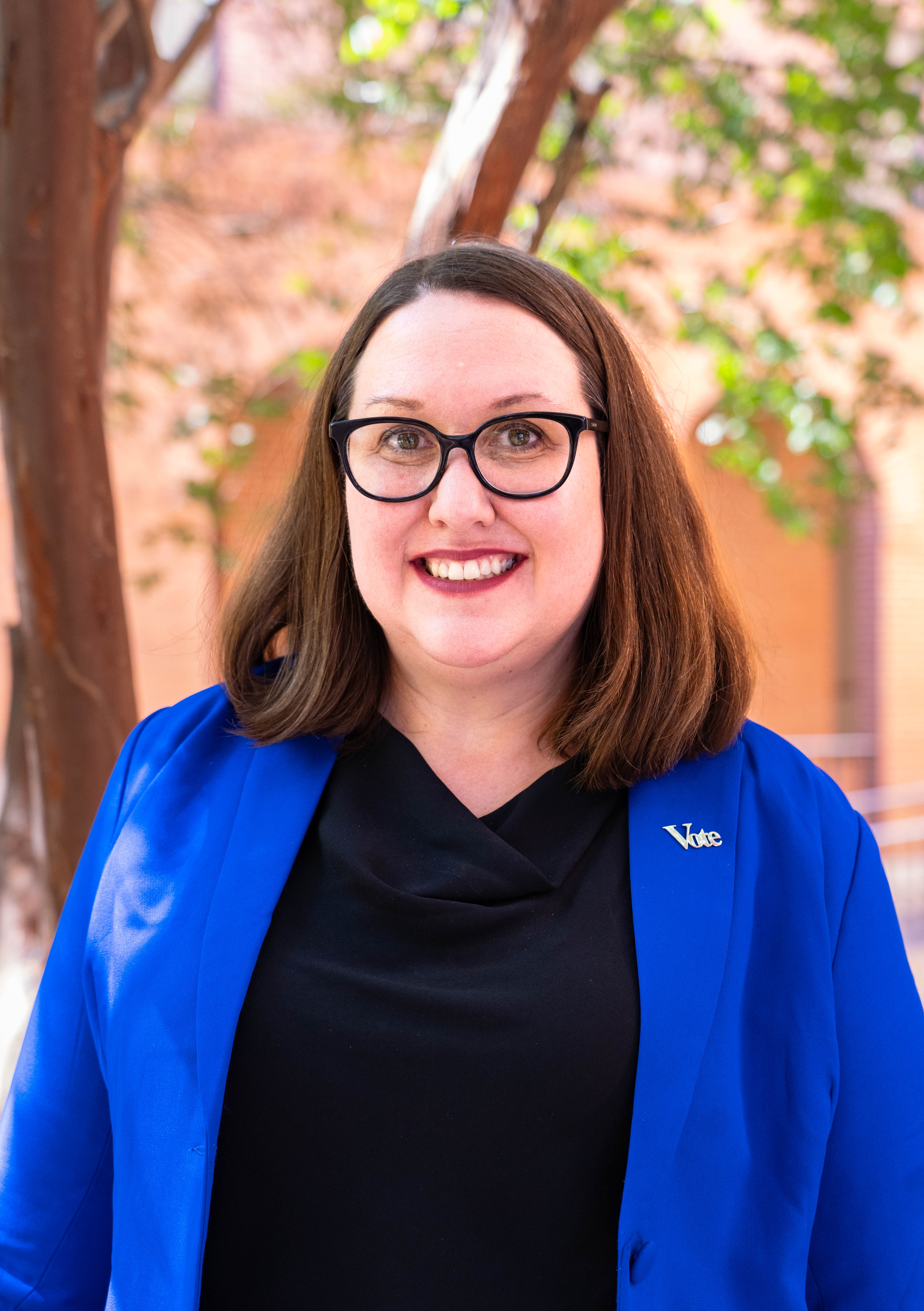
Dr. Rebecca Flavin, Senior Lecturer in Political Science, serves as the Director of Engaged Learning Curriculum in the Office of Engaged Learning. She also directs Baylor's Model UN program and serves as Associate Director of Baylor in Washington.
This conversation with Dr. Andy Hogue is the second installment of our "Get to Know the OEL" series. You can read the first installment, with Dr. Dwayne Simmons, here.
AH: Who is Rebecca Flavin? Where did you come from, and how did you make your way here?
RF: I grew up in central West Virginia in a county that had a single stop light for just a hot second when a one-lane bridge was under repair. In other words, it was a small town. After high school I attended Wheeling Jesuit University located in the northern panhandle of West Virginia which is so narrow you can say you’ve been in three different states in fifteen minutes’ time if you push the speed limit on I-70 while driving across it between Bridgeport, Ohio and West Alexander, Pennsylvania. After WJU I attended the University of Notre Dame in South Bend, Indiana for my MA and PhD in Political Science, where I met my husband, Pat, who is also a Political Scientist. By the grace of God we both landed full time positions at Baylor in 2010, and we moved to Waco three days after our wedding with some of our wedding gifts still in wrapping paper in the back of the moving truck. We have both been here, in our first jobs, since then.
AH: How did you develop your teaching and research interests? What led you to the questions you spend your energy on as a teacher and scholar?
My favorite subjects were always social studies, literature, English, and history, but I fell in love with studying the Constitution in my high school A.P. Government and Politics course. In that course we prepared for the “We the People: The Citizen and the Constitution” competition hosted by the Center for Civic Education, which, incidentally, celebrates its 60thanniversary this year. My best friend, Sally Ann, who was also in the class, and I would drive nearly 50 miles one way to the Kanawha County Public Library in Charleston, WV to use their Supreme Court summary books on Saturdays as we wrote our oral arguments for the competition. This will date me a bit for my students, but this was back before Wi-Fi existed and dial-up internet was exorbitant – six dollars for a minute of AOL, I recall. So, doing internet research was not a possibility for us. But, it did not feel like work at all, doing that reading, and we would lose track of time after reading and photocopying for hours. The hard work paid off; our team won first place in the state of West Virginia and went onto nationals in Washington, D.C. (But, for the sake of full disclosure, I need to be honest that none of the other teams were able to make it to the competition that day due to a snowstorm that hit while we were driving in. So, but for that intrepid Clay County bus driver who was not deterred by the snow and plowed on anyways, I might not be here!) The competition was held at West Virginia University’s law school, and it was my first time on that campus or at a law school. I thought, “Is this what lawyers do – talk about the Constitution and exciting First Amendment cases (my assigned topic area for the competition)? I should be a lawyer!” That was when I shifted from wanting to be a high school teacher to planning for law school.
I choose WJU because they gave me an amazing scholarship but also because they touted a 100% law school success rate. My second choice, Marshall University, seemed too big for me. I loved WJU’s small community that was just twice as big as my high school, but it was also at this time that I was starting to explore my faith. So, WJU was further appealing to me in that it had a religious identity that was very much a part of the curriculum and campus life, though, at the time, I was not Catholic. It was at WJU that the Jesuits ignited my love of philosophy but that, more importantly, my undergraduate advisor, Dr. Robert Philips sent me a link (yes – link – the internet existed by then and was free to use on campus) to a law school catalog and a graduate school catalog and asked me, “McCumbers, which do you want to spend your time studying?” It turned out that law school was not just about studying constitutional law but involved things like torts, contracts, and tax law that sounded as enjoyable as a root canal to me (no offense meant to any lawyers who love studying those things). The graduate school catalog, in contrast, had more courses that appealed to me and my intellectual interests – political philosophy, politics and religion, and constitutional law.
AH: What do you love about working at Baylor?
That is an easy one - my students. My students give me so much joy, and it is both humbling and gratifying when I am able to witness a student grow over their time at Baylor and beyond and think about the small role I play in that. In Model UN, especially, I have been blessed to work closely with so many incredible students and see them blossom as students and leaders. What keeps me grounded (and why I emphasize that it is humbling) is knowing that when those students walk through the door at conference, they know far more about the topics they have researched than I do. (My colleagues are really amazing, too!)
AH: You wear a lot of hats at Baylor. Tell us about your various roles. And how on earth do you manage to do them all?
My email signature has gotten a little out of control the past two years, hasn’t it, but I suppose I can partially blame you for that for affording me these wonderful opportunities?! In the Office of Engaged Learning my official title is “Director of Engaged Learning Curriculum,” which means I get to work with faculty across the college, especially, but even outside the college as they develop courses for the A&S Core’s new Engaged Learning Distribution List. This means I am charged with helping faculty take a vision and turn it into a course that offers a truly transformational learning experience for our students but, more importantly, provides a vehicle for work that helps to make the world a better place. This year I also stepped into an additional role in OEL, directing the undergraduate Philanthropy and Public Service Program, and in that capacity, I have the privilege of connecting with community partners who bring their expertise in the local nonprofit and government space into Baylor classrooms, where they are offering courses that I wish I could take. This semester I added an additional hat as Associate Director of Baylor in Washington, working alongside Dr. David Corey, who is the director; we make up the Waco-based staff who advise our D.C.-based staff who are in residence year-round supporting the semester and Baylor in Washington internship program and the Summer Fellowship in Religion and Public Life. These are my newer hats, but in addition to these I am a senior lecturer in Political Science where I have taught courses in constitutional law, Model UN, politics and religion, and political philosophy since 2010. Last summer I also wrapped up a three-year term as the Undergraduate Program Director for PSC.
AH: One of my favorite things about working with you, Rebecca, is the fact that you are never far from a laugh and never far from making someone else laugh. Why do you think that is? And how would you encourage others to take delight in their work?
One of the most cutting pieces of feedback I received on course evaluations was from a student who declared that my jokes are “awful” and that he/she would help me write better ones. Alas, those evaluations are anonymous, so I was not able to cash in on that offer. So, I am glad someone finds my jokes funny. I had a professor in graduate school, Ben Radcliff, who included as a course prerequisite “having a sense of humor.” At the time I thought that was a bizarre thing to put on a syllabus, but I came to appreciate it. That professor was an influential mentor, and he, sadly, passed away last year. In his eulogy published in our discipline’s major journal he was celebrated for his scholarly work on happiness but also for his incredible sense of humor. Because I took his research methods class I know better than to say those are causally connected, but I can confidently say I bet there is a correlation between having a good sense of humor and being happy. (Yes, that was intended to be a social science pun.)
AH: What do you do for fun outside work?
I love to travel, so I spend more time than I should admit dreaming up trips I want to take and planning trips to take on breaks between classes. I also love to read and work in my pollinator garden and vegetable beds. However, I have a brown thumb and managed to harvest just 6 tiny broccoli crowns this winter. My guilty pleasure is watching cheesy Hallmark movies.